Sweet 16 30 Mar 2016 5:17 AM (9 years ago)

This week, NextMark celebrates its 16th anniversary.
NextMark opened its doors on March 28, 2000 with a team of 5 people and some crazy ideas. Thanks to you, our customers, the company is still going strong sixteen years later. Sure. there’s been some ups and downs along the way, especially in the early years surviving the “dot com bust.” Those were lean times. But we made through and have grown to become the industry standard for list brokerage and list management thanks to your ideas, guidance, and trust over all these years. And now we are becoming the new industry standard for media planning and buying through our Bionic Advertising Systems line of products.
With your continued trust and guidance, we’ll be serving you for many more years to come.
Thank you.
The post Sweet 16 first appeared on NextMark.


28 List Managers Score Perfectly in NextMark’s January 2015 Data Card Quality Report 27 Jan 2015 11:54 AM (10 years ago)
NextMark today announced its January 2015 Quarterly Data Card Quality Report. Of the 176 list management companies covered by this report, 28 scored a perfect 100 for their data card portfolio.
The companies with perfect quality scores include ALC, Ameliorate Data Solutions, Inc., B2B, Complete Mailing Lists, Complete Medical Lists, DATALINE, Direct Market, LLC, Dunhill International List Co., eTargetMedia.com, Exact Data, Fresco Data, Great Lakes List Management, Healy List Marketing, Integrated Business Svcs, Lighthouse List Co., List Connection Inc., List Service Direct, Inc., ListBargains.com, Media Source Solutions, Inc., Midwest Trading Post, Paramount Lists, Inc., Political Fundraising Lists, Profile America List Company, Inc., Sprint Data Solutions, LLC, Take 5 Solutions, The List Experts, The Standard Information Company, and WS PONTON.
The complete data card quality report can be found on NextMark’s website at: http://nextmark.com/media-sales/data-card-quality-report/
Data cards are the primary documents used in circulation planning and purchasing decisions. Publishing a high quality data card maximizes the likelihood of being selected for inclusion in direct marketing campaigns.
NextMark rates the quality data cards by electronically analyzing more than 100,000 data cards in its directory. For each data card, a proprietary algorithm first rates the quality of 13 key attributes. Then, the score (0-100) for the data card is calculated using a weighted average of the 13 attributes. The list management company’s quality score is the average score of all data cards in their portfolio. List managers can access the details of the calculation and suggestions for improvement through NextMark’s free data card publishing tool (a.k.a. the “Data Card Wizard”).
The post 28 List Managers Score Perfectly in NextMark’s January 2015 Data Card Quality Report first appeared on NextMark.
NextMark Spawns Bionic Advertising Systems 22 Oct 2013 7:11 PM (12 years ago)
NextMark today announced the creation of Bionic Advertising Systems, a new division focused on delivering technology that streamlines digital advertising workflow for digital marketers, their advertising agencies, and publishers.
“The new Bionic brand represents our philosophy of delivering advertising technology that combines the strengths of humans and machines,” remarked Joe Pych, CEO of NextMark, and co-founder of Bionic. “Over the past few years, there’s been a battle of man versus machine in digital media. Neither side is winning. Instead of man or machine, the best ‘systems’ of the future will be a combination of both. The recent announcements by AOL,Yahoo!, and Microsoft around Programmatic Direct validate this belief and heralds a new age in digital advertising: the Bionic Age. As the name implies, our new Bionic unit is 100% dedicated to delivering solutions for this new era in digital advertising.”
Launched today, Bionic Advertising Systems will encompass NextMark’s solutions for digital advertising, including the latest Programmatic Direct technologies. Bionic’s software automates the mundane processes of digital media planning, buying, and ad operations. It frees media planners, buyers, and sellers to spend their time on higher-value tasks. It enables digital media planners to find advertising opportunities, gather information, create and send requests for proposals, negotiate with publishers, build media plans, execute orders, and implement their campaigns with the click of a button. With its modern API-driven architecture, it integrates with popular agency tools such as Doubleclick, MediaMind, and comScore. It’s currently integrating with leading sell-side Programmatic Direct technology providers Adslot, iSocket, and Yieldex. Bionic’s Digital Media Planner aims to tie together the many disparate systems used in digital advertising, giving them a single interface that simplifies the way they develop and deliver media plans.
“’Bionic’ is such a great concept for the digital media industry,” added Chris O’Hara, the business unit’s co-founder and Chief Revenue Officer. “A lot of companies in the space think that algorithms and robots are the answer. We know human creativity can be unleashed by automation, and that digital advertising works best when people are empowered by technology.”
Currently, more than forty advertising agencies are using the Bionic Digital Media Planner to create and execute their media plans. More than 900 publishers and networks are using the Bionic Digital Ad Sales System to promote more than 9,000 premium digital advertising programs—the largest directory of its kind, which also powers the IAB’s Digital Advertising Directory.
To learn more, visit the Bionic website: http://www.bionic-ads.com/
The Great Time Suck 23 Sep 2013 8:10 PM (12 years ago)

Nearly 70% of the $9 billion display media market still occurs in the “transactional RFP” channel. Source: Arkose Consulting
This post originally appeared in AdExchanger
Why Publishers Hate the Transactional RFP Business
I have been thinking about, and trying to solve, agency digital workflow problems since 2008.
Given the complexity of digital media, the variety of creative sizes, millions of ad-supported sites, and dozens of ad servers, analytics platforms, order management and billing tools, it goes without saying that the digital marketing stack has been hard for any agency to put together.
Recent research has tracked the immense level of complexity involved in digital media planning (more than 40 steps) and the tremendous expense involved in creating the actual plan (up to 12% of the media spend). It all adds up to a lot of manual work for which agencies are not willing to pay top dollar, along with frustrated agency employees, overbilled clients and a sea of technology “solution providers” that only seem to add to the complexity.
Media planning on the agency side is a big time suck. Yet some agencies are still getting paid for it, so it’s a problem that is going to get solved when the pressure from agency clients increases to the point of action, which I think we’re just now hitting in 2013.
But who is thinking about the publishers? Despite dozens of amazing supply-side technologies for optimizing programmatic RTB yield, there are only a few providers focused on optimizing the 70% of media dollars that flow through publishers’ transactional RFP channels.
DigiDay and programmatic direct software provider AdSlot and recently studied the transactional costs of RFPs. The sheer numbers stunned me. Here’s what one person can spend on a single RFP:
- 5.3 hours on pre-planning
- 4.2 hours on campaign planning
- 4.0 hours on flighting
- 5.3 hours on maintenance
- 3.3 hours post-campaign
That’s more than 22 hours – half a business week – spent creating a single proposal and starting a campaign, which, according to the study, has a less than 35% chance of getting bought and a staggering 25% chance of getting canceled for performance reasons after the campaign begins. The result is a 25% net average win rate. That’s a lot of work, especially when you consider how easy it is for agencies to lob RFP requests over the transom at publishers. On average, publishers spend 18% of revenue just responding to RFPs, which translates to 1,600 man-hours per month, according to the study.
So, we have a situation in which agencies, which are firmly in control of the inventory procurement process, are not only wasting their own time planning media, they are also sustaining a system in which their vendors are wasting numerous hours comporting with it. In short, agencies spray RFPs everywhere, and hungry publishers respond to most. The same six publishers make the plan every year, and a lot of publishers’ emails go unanswered. What a nightmare.
A Less-Than-Perfect Solution
To combat this absurdity, many publishers have placed large swaths of their mid-premium inventory in exchanges where they realize 10% of their value but avoid paying for 1,600 hours of work. The math isn’t hard if you know how agencies value your inventory. Publishers aren’t stupid. Inventory is their business, and most work very hard creating content to create those impressions. These days, every eyeball has a value. Biddable media has made price discovery somewhat transparent for most inventories. Programmatic RTB is great, but not all publisher inventories are created equal. A small, but highly valuable percentage will never find its way into an SSP.
Publishers will always want to control their premium inventories as long as they receive a greater margin after transactional RFP labor costs. Publishers who actually have strong category positioning, contextual relevance, high-value audience segments and a brand strong enough to offer advertisers a “halo” have to manage their transactional business so they can maintain control over who advertises and what they pay. This looks the year that demand- and supply-side software solutions may finally come together to solve the problem of “transactional RFP” workflow.
A couple of new developments:
- Demand-Side Procurement Systems Are Evolving: Facing significant pushback from clients and seeing new and accessible self-service media buying platforms gain share, agencies are looking hard at tools to gain efficiency. Incumbent software systems like Strata and MediaOcean are modernizing, while new, Web-based tools are gaining adoption among the middle market. Suddenly workflow efficiency is all the rage and agencies that spend 70% of their money in the transactional RFP space want a 100% solution.
- Supply-Side Direct Sales Systems Are Available: A few years ago, there were lots of networks and marketplaces for publishers to put inventory before going directly into exchanges. Many were more generous than today’s exchanges, but still offered low-digit CPMs and not much control over inventory. Now there are a variety of systems that plug directly into DFP and enable publisher sales teams to have real programmatic control over premium inventory. AdSlot, ShinyAds and iSocket are rapidly gaining adoption from publishers that want another premium channel to leverage, without giving up pricing control. To succeed, these publishers’ systems must be connected to the platforms that manage demand.
- Who Put Peanut Butter Into My Chocolate? What is slowly happening, and will continue in a huge way in 2014, is that demand- and supply-side workflow solutions will come together. What does that mean from a practical standpoint? Planning systems will be able to communicate with ad servers, eliminating double entry work; ad servers will be able to communicate with order management and billing systems, eliminating even more duplicative work; and the entire demand side system will be able to communicate orders directly into the publisher workflow systems and ad server.
Simply put: Agencies will be able to create a line item in a media plan, electronically transmit an order to a publisher, which the publisher will electronically accept, and the placement data will be transmitted into the publisher’s ad server. A line item will be planned, and it will begin running on the start date. Wow.
That’s what we are starting to call programmatic direct. It’s a world with a lot less Excel and email, with thousands of hours that won’t get wasted on transactional RFP workflow for agencies and publishers.
What kinds of amazing things can do with all that extra time?
The post The Great Time Suck first appeared on NextMark.
The Hourglass Funnel Changes Everything 19 Sep 2013 5:53 AM (12 years ago)

Lately, I’ve been thinking a lot about the hourglass funnel. Most funnels stop at the thin bottom, when a customer “drops” out, having made the journey through awareness, interest, desire and action. After the “action,” or purchase, the customer gets put into a CRM to be included in more traditional marketing outreach efforts, such as calls, e-mails, and catalogue mailings. In the past, marketers often thought about how to turn customers into advocates, but couldn’t figure out how to do it at scale. Companies that were really good at multi-level marketing, like Amway, didn’t have easy-to-replicate business models.
Today, the situation has changed. Social-media platforms give marketers tools to engage customers in their CRMs and bring them back through the bottom of the funnel, turning them into brand advocates — and maybe even salespeople. This is why Salesforce has been snatching up social-media companies like Radian6 and Buddy Media, while Oracle bought Vitrue and Involver. These platforms can help get people talking about your brand– and, in turn, you get to listen to what they have to say. These platforms also can help you understand what it takes to get your customers to move from liking your page to actively sharing your content and to actually recommending your products and even selling them as an affiliate.
The ad-tech revolution of the last several years has supercharged our ability to drive people through this hourglass-shaped funnel. But instead of enabling this movement, we have instead – for the most part — focused on wringing efficiency out of reaching the customers we’re already very close to getting. For example, programmatic RTB makes it easy to bid on people in the “interest” layer, who behave like existing customers. Additionally, it’s a no-brainer to retarget those customers who have already expressed “desire” by visiting a product page or your website. And technology also makes it increasingly easy to invite customers already in your CRM to “like” your Instagram page, or to offer them incentives to “recommend” products through social sharing tools.
But what about the very top of the funnel (awareness) and the very bottom (advocacy)? Those are the two most critical parts of the marketing hourglass funnel, but the two least served by technology today. While we have tools to drive people through the marketing process more quickly or cheaply, technology doesn’t create brands or turn social-media fans into brand advocates.
However, the right strategy for both ends of this funnel can still boost awareness and advocacy by creating a branding vortex that is a virtuous circle. Let me explain:
Awareness
You can’t start a customer down the sales funnel without making he or she aware of your product or service. Despite all of the programmatic promise in display, technology mainly emphasizes reaching our known audience most efficiently. It simply hasn’t yet proven that it can create new customers at scale. That’s why TV still gets the lion’s share of brand dollars. Cost-effective reach, pairedwith a brand-safe, viewable environment, is what TV supplies.
In my opinion, the digital answer for raising awareness is starting to look less and less like programmatic RTB and more like video and “native” formats, which are more engaging and contextually relevant. Also, new programmatic direct technologies are starting to make the process of buying guaranteed, premium inventory more measurable, efficient and scalable.
Programmatic RTB advocates will argue that you can build plenty of awareness across exchanges, but it’s hard to create emotion with three IAB standard units, and there still isn’t enough truly premium inventory available in exchanges today to generate a contextual halo for your ads. New “native” display opportunities, video and tablet advertising are where branding has the biggest impact. Adding those opportunities to social tools, such as Twitter and Instagram, would help you leverage your existing brand advocates and amplify your message.
Advocacy
Great digital branding at the “awareness” level of the funnel not only helps drive potential new customers deeper into the sales funnel, but also can help engage existing customers. This amplification effect is extremely powerful. Old-school marketers such as David Sarnoff understood that folks make buying decisions through their friends and neighbors. He also understood that, when you’re trying to sell the next big thing (like radio), you have to leverage existing media (print). Applied to digital marketing, this simply means leveraging awareness media — TV, video and “native” advertising — to stimulate word-of-mouth advertising, which is still the most powerful type. By using Facebook and other social sharing tools, the effect of any campaign can grow exponentially in a very short period of time. This virtuous circle of awareness media influencing brand advocates, who then create more awareness among their own social circles, is something that many marketers miss when they lead their campaigns with data rather than with emotion.
Everything In Between
I’m not saying that marketers can simply feed the top of the funnel with great branding and ignore the rest. That’s not true at all; the middle of the funnel is important too. I think it’s relatively easy, nowadays, to build a stack that also helps support all the hard work that brands are doing to create awareness. Most large marketers reinforce brand efforts with “always on” programmatic RTB that targets based on behavior, and all brands employ as much retargeting that they can buy. Once customers are in the CRM, it’s not hard to maintain a rewards/loyalty program, and messaging to an existing social fan base also is relatively simple.
But marketers are making a mistake if they think that this kind of programmatic marketing can replace great branding. With so many different things competing for customers’ attention, capturing it for more than a second is extremely difficult, and the challenge is only going to get harder.
The Datalogix Effect
So what does all this mean for for ad technology? The best way to think about this is to look at theDatalogix-Facebook partnership. Datalogix’s trove of customer offline purchase data essentially enables brands to measure whether or not all their social-ad spending resulted in more online sales. A few studies have pretty much proven that media selling soap suds on Facebook created more suds sales at the local Piggly Wiggly. In fact, ROI turns out to be easy to calculate, as well as positive.
This type of attribution seems simple, but I don’t think you can overstate its impact. It’s the way we finally move from clicks and views to profit-optimization metrics such as those offered by MakeBuzz. And this method of tying online activity with offline sales is already having a vast impact on the ecosystem. It shows, beyond doubt, that branding sells product.
Getting the attribution right, though, means that brands are going to have to care about creative and content more than ever. It means big wins for video, “native” ad approaches, and big tentpole marketing campaigns. If quality premium sites can be bought programmatically at scale, then it may also mean big wins for large, traditional publishers.
It also likely means that many retargeters, programmatic RTB technologies and exchanges could end up losing in the long run. Don’t get me wrong: These technologies are needed to drive the “always on” machine that powers the middle of the funnel. But just how many DSPs and exchanges does the industry need to manage its commoditized display channel?
As marketers realize that they are spending money to capture customers that were going to convert anyway, they’re likely to focus less on audience targeting and more on initiatives to create new customers — and turn existing customers into advocates.
[This post originally appeared in AdExchanger]
The post The Hourglass Funnel Changes Everything first appeared on NextMark.
NextMark Hires Mark Winberry as Director of Product Management 11 Sep 2013 12:32 PM (12 years ago)

NextMark today announced it has hired Mark Winberry as its Director of Product Management. In this role, Mark will lead the group that establishes the roadmap for all products, designs the user experience, and ensures the quality of product upgrades and enhancements. His initial focus will be on NextMark’s newest products that automate digital advertising workflow for “programmatic direct” advertising: Planner for media planners at advertising agencies and Compass for ad salespeople at publishers.
“Mark is a great addition to the team,” said Joe Pych, NextMark’s founder and president. “Skillful product management is critical to the success of our new offerings. Frankly, we’re overwhelmed with the fantastic ideas we’re getting from early clients. It’s a huge challenge to combine that feedback with our own vision to quickly deliver elegant solutions. It requires a unique combination of imagination, work ethic, design sense, technical knowledge, and interpersonal skills to be successful. Mark’s the right guy for this job.”
Mark brings more than 20 years experience in software development to NextMark. Most recently, Mark served as the Senior Director of Engineering for Acquia – a software and hosting company that enables enterprises to efficiently build, deploy and manage hundreds of Drupal websites. Prior to that, Mark was the president of Trebuchet Development – a Software Development & Scrum/Agile consulting business. Prior to that, Mark served in various engineering and management roles at TomTom/TeleAtlas, Microsoft, Vicinity, Tally Systems, and Terra-Map East. Mark holds a BA in Mathematics from Harding University.
“I am thrilled to be joining the world-class team at NextMark,” said Mark Winberry. “The deep marketing automation experience of this team is unparalleled. That experience, combined with the best Market Intelligence database is enabling us to create the foremost media planning experience in the industry. I’m looking forward to leveraging my product development experience to help NextMark customers grow their businesses by delivering them the highest quality marketing automation solutions!”
Mark is already on the job working to deliver version 2.4 of Planner, which is scheduled to be released next week.
The post NextMark Hires Mark Winberry as Director of Product Management first appeared on NextMark.
Google recognizes NextMark’s Edmond location as the 2013 eCity of Oklahoma 10 Sep 2013 1:13 PM (12 years ago)

We’re sometimes asked “why do you have an office in Edmond, Oklahoma?” With so many of our customers located in the New York Metro area, it may seem an unusual location for an office.
The main reason NextMark is in Edmond is because we have a great team there. They joined NextMark along with our 2008 acquisition of Marketing Information Network. These Market Intelligence Specialists are the brains and the brawn that creates the data cards you find our Mailing List Finder and Digital Advertising Directory. They’ve decades of experience gathering, standardizing, cataloging, and curating information about advertising programs in all kinds of media channels – we currently support 18 media channels ranging from trusty old postal mail to the latest digital advertising channels. Their experience shows in the accuracy and comprehensiveness of more than 125,000 listings in NextMark’s directories.
Another reason is the great business environment in Edmond. We’re not the only ones that think so: Google last week recognized Edmond, Oklahoma as the 2013 eCity of Oklahoma for being the strongest online business community in the state. Edmond is one of a select few cities in the U.S. that won this award.
Congratulations to the city and all the businesses in Edmond for being recognized for what we already knew: it’s great to be in Edmond!
The post Google recognizes NextMark’s Edmond location as the 2013 eCity of Oklahoma first appeared on NextMark.
NextMark Now Enables Private Deals for Direct Ad Buys 23 Aug 2013 4:00 AM (12 years ago)

NextMark today unveiled new features in its Digital Media Planner tool that enable media planners to record and utilize private advertising deals when creating their media plans.
Keeping track of special advertising deals is a challenge for advertising agencies and for their media planning teams. In the past, media planners had to rely on their own memory and files to recall the special deals they’ve made with publishers. And it was difficult to know if others at your agency had already established a deal with a given publisher. With these issues combined with time pressure and the high turnover in those positions, special deals deals are often overlooked and negotiating leverage is lost. Ultimately, advertisers’ working media dollars are wasted every time a deal is missed.
NextMark Planner solves this problem by enabling you to enter your private deals directly onto the publisher’s data card adjacent to their standard placements and prices. With Planner, you can now set your own prices and create your own custom placements. You can see if others at your agency already have a special deal in place. Your special deals are stored securely and only available to authorized planners at your agency.
These special deals come in handy when you’re creating your media plans. Planner automatically displays all your agency’s custom placements and automatically defaults to your special rates. You’ll never again be embarrassed by missing out on a deal.
Along with the previously released private marketplace features, these new features give you a powerful tool to create and maintain your own directory of preferred vendors, contacts, and deals.
You can request your free trial of Planner here: http://nextmark.com/planner.
The post NextMark Now Enables Private Deals for Direct Ad Buys first appeared on NextMark.
The Unexploited Middle 21 Aug 2013 1:18 PM (12 years ago)

Programmatic Direct technology will make it easy for the demand side to exploit this rich pocket of quality inventory.
I recently sat through some great presentations on “programmatic direct” media buying at the recent Tech for Direct event in New York. With almost 70% of digital display dollars flowing through the negotiated (RFP) market, everyone wants to be in the game. One of the presenters, John Ramey of iSocket talked about what has happened to the advertising yield curve for digital display. This curve starts at the upper left corner with premium inventory capturing the highest CPMs, and is supposed to flow gently downward on the x-axis, towards the lowest value of inventory, ending on the lower right corner. A classic marketplace yield curve. In this world, ESPN can charge $20 CPMs for their baseball section, sites like Deadspin in the mid-tail can charge $7, and the networks and exchanges aggregating hundreds of sports blogs in the long tail can charge $1. Nice and fair, and rational.
This is not what has happened, though.
As Ramey correctly points out, we have a yield cliff now. This is world in which there are two types of inventory: The super-premium, which is hand sold directly for double-digit CPMs; and the remnant, which is sold via RTB on exchanges or surviving ad networks, often for pennies. In this world of the Haves and Have-Nots, there is no middle class of inventory—even though one could argue that $7 inventory on Deadspin might actually outperform its upscale cousin, ESPN. This inventory disparity we have created in the digital advertising industry has nothing to do with supply and demand, but everything to do with the process by which we transact.
Premium mid-tail buying is a great idea. Back in 2009, marketplace platforms like TRAFFIQ were bringing this innovation to the space, and enabling marketers to cherry pick and aggregate premium quality sites that could offer friendly CPMs and URL-level transparency. It’s not a new concept. In fact, I think premium mid tail buying is the canary in the coalmine for programmatic direct; when today’s technology can make it easy to put together a large array of guaranteed buys, and enable fast and easy optimization, then we will have succeeded. Here what was missing in 2009, and what we need to succeed today:
- A Centralized Directory: You can’t buy stuff without knowing what’s available and how much it costs. Other media channels like direct mail have published prices for mailing lists, right down to audience targeting. You want to reach people who have bought something from the Cabela’s catalog in the last six months, and restrict the mailing to men only? No problem. You can find out what it costs, and who sells it. The digital display market needs to be organized in a directory, down to the placement level. You shouldn’t have to wait for an e-mail back from an RFP to find out what known inventory costs. That work is being done now, but has a lot more work to go through before it is comprehensive.
- An Extensible Platform: Today’s API-driven technology makes it easy to enable buying directly into publishers’ inventory. A link into DFP means buyers can discover availability and start serving ads with a few button clicks. The problem is that agencies want a Single System to Rule Them All. So far, agencies have been stuck with installed, legacy systems that have more to do with billing and reconciliation than media planning and buying. Agencies want new, web-based ways to discover and buy great inventory, but they also want a system that plugs into their existing tools. They are not going to log into another buying system if they don’t have to. A system that can enable premium mid-tail buying at scale either has to integrate directly into existing media management systems—or replace them. Right now, there are a lot of tech companies at work retrofitting old technology or creating new technology that promises to make this a 2014 reality. It’s a horse race, and agencies are starting to place their bets. The winners are the one with the most extensible platforms that are good at integration, and they will be richly rewarded. The rest will fail, or become a point solution in someone else’s platform.
- The Right Model: This is may be the most important factor in determining programmatic direct success. If you are charging anywhere north of 10% (and some would argue a LOT less than that) to help media buyers aggregate inventory, then you are not a “programmatic direct” technology company. You are an ad network, or media rep firm. The reason for industry consolidation is because disintermediation through technology has its own yield curve: The disruption that occurs always benefits the middle layer first, but markets always rationalize later. Mike Leo, former Operative CEO, told me about how another industry solved a similar problem that was occurring in the media business, where ad agencies were starting to rebel against specialized media buyers who in the middle of the transaction, with opaque pricing methodologies. The year was 1968, and agencies teamed up and decided that a standard rate of 15% was all they were willing to pay for television buying services (and then they eventually bought all of the media buying companies, but that’s another story). Anyway, markets always rationalize themselves, and right now even 15% feels like a big vigorish for agencies with ever-shrinking margins on their media practice.
- Standards: It’s 2013, and we are still faxing IOs. This is largely because there are no accepted standards—and no protocol—for electronic orders. This is actually not a hard problem to solve, but getting adoption from buyers and sellers is what’s needed. Right now, a few companies are working with groups like the IAB to get real traction with standards, and we need that to succeed to make programmatic direct buying a scalable reality. Electronic orders suck a lot of the viscosity out of the deal pipeline, and start to let the machines do the grunt work of order processing, rather than a $50,000 junior media planner.
The good news is that there has been a tremendous amount of progress in 2013 on all of these initiatives. The promise of true programmatic direct buying is closer than ever, and there is enough real development behind the hype to make these dreams of efficient media buying a reality in the near future. In that future, it just may be possible for a buyer to use demand-side technology to aggregate the “fat middle” of premium mid tail publishers, and start to reward the middle class of inventory owners who are currently getting paid beer prices for champagne content.
The post The Unexploited Middle first appeared on NextMark.
We’re hiring: Bookkeeper / Office Manager – Hanover, NH 21 Aug 2013 6:58 AM (12 years ago)

Would you like to join the NextMark team to help with accounting and office management? NextMark has a new job opening in its Hanover, NH headquarters that can be either part-time or full-time with a flexible work schedule. For more information and to apply, visit our Bookkeeper / Office Manager job listing.
The post We’re hiring: Bookkeeper / Office Manager – Hanover, NH first appeared on NextMark.
A Contrarian View of Programmatic RTB 7 Aug 2013 1:14 PM (12 years ago)

Online display would be like this, if branding metrics took profit into account.
I’ve always loved the notion of programmatic RTB. As a data hound and an early adopter of Appnexus , the notion that advertisers can achieve highly granular levels of targeting and utilize algorithms to impact performance is right in my wheelhouse. Today’s ad tech, replete with 300 companies that enable data-driven audience segmentation, targeting, and analytics is testament to the efficiency of buying ads one impression at a time.
But what if driving efficiency in display actually does more harm than good?
Today’s RTB practitioners have become extremely relentless in pursuit of the perfect audience. It starts with retargeting, which uses first party data to serve ads only to people who are already deeply within the customer funnel. No waste there. The next tactic is to target behavioral “intenders” who, according to their cookies, have done everything BUT purchase something. Guess what? If I have searched 4 times in the last three hours for a flight from JFK to SFO, eventually you will get last view attribution for my ticket purchase if you serve me enough ads. Next? Finding “lookalike” audiences that closely resemble past purchasers. Data companies, each of whom sell a variety of segments that can be mixed to create a 35 year-old suburban woman, do a great job of delivering audiences with a predilection to purchase.
But what if we are serving ads to people that are already going to buy? Is efficiency really driving new sales, or are we just helping marketers save money on marketing?
It seems like online display wants to be more and more like television. Television is simple to buy, it works, and it drives tons of top funnel awareness that leads to bottom funnel results. We know branding works, and even those who didn’t necessarily believe in online branding need look no further than Facebook for proof. With their Datalogix offline data partnership, Facebook conclusively proved that people exposed to lots of Facebook ads tended to grab more items off of store shelves. It just makes sense. So why are we frequency capping audiences at 3—or even 10? I can’t remember the last time I watched network television and didn’t see the same car ad about 20 times.
The other thing that RTB misses out on is profit. RTB drives advertising towards lowering the overall cost of media needed to drive a sale. Even if today’s attribution models were capable of taking into account all of the top-funnel activity that eventually creates an online shopping cart purchase (a ludicrous notion), we are still just measuring those things that are measureable. TV ads, billboard ads, and word of mouth never get online credit—yet I believe they drive most of the online sales. Sorry, but I believe the RTB industry creates attribution models that favor RTB buying. Shocking, I know.
So, what is true performance and what really drives it? For most businesses, performance is more profit. In other words, the notion that a sales territory that has 100 sales a day can generate 120 sales a day. That’s called profit optimization. If I can use advertising to create those additional 20 sales, and still make a profit after expenses, than that’s a winner. RTB makes it cheaper to get the 100 sales you already have, but doesn’t necessarily get the next twenty. Getting the next batch of customers requires spending more on media, and driving more top-funnel activity.
The other thing RTB tends to fumble is how real life sales actually happen. Sure, audience buying knows what type of audience tends to buy, and where to find them online, but misses with frequency capping and a lack of contextual relevance. Let me explain. In real life, people live in neighborhoods. The houses in those neighborhoods are roughly the same price, the kids go to the same school district, the people have similar jobs, and their kids do similar activities and play the same sports. The Smiths drive similar cars to the Joneses, they eat at the same restaurants, and shop at the same stores. If the Smiths get a new BMW, then it’s likely the Joneses will keep up with a new Audi or Lexus in the near future. When neighbors get together, they ask each other what they did on February Break, and they get their vacation ideas from each other. That’s how life works.
What media most closely supports this real-life model, where we are influenced most by our neighbors? Is it serving the Jones family a few carefully selected banners on cheap exchange inventory, which is highly targeted and cost effective? Or is it jamming the Smiths and Joneses with top-funnel brand impressions across the web? The latter not only gets Smith, the BMW owner, to keep his car top-of-mind and be more likely to recommend it—but also predisposes Jones to regard his neighbor’s vehicle in a more desirable light. That takes a lot of impressions of various types of media. You can’t do that and remain efficient. The thing is—you can do that and create incremental profit.
Isn’t that what marketers really want?
[This post originally appeared in AdExchanger]
The post A Contrarian View of Programmatic RTB first appeared on NextMark.
Complexity is the Digital Ad Agency’s Best Friend 24 Jul 2013 1:07 PM (12 years ago)
-

Agencies are afraid of change, but change always happens. Is your manual workflow a “red stapler?”
I once heard Terence Kawaja remark that “complexity is the agency’s best friend.” It’s hard to argue with that. Early digital agencies were necessary because doing things like running e-mail campaigns, building websites, and buying banner ads were really complicated. You needed nerdy guys who knew how to write HTML and understood what “Atlas” did. Companies like Operative grew admirable services businesses that took advantage of the fact that trafficking banner ads really sucked, and large publishers couldn’t be bothered to build those capabilities internally. The early days were great times for digital agencies. They were solving real problems.
Fast forward 13 years. Digital agencies are still thriving, mostly by unpacking other types of complexity. “Social media experts” were created to consult marketers on the new social marketing channel, “trading desks” launched to leverage the explosion of incomprehensible RTB systems, and terms like “paid, owned, and earned” were coined to complexify digital options. It’s hard being a marketer. So much easier to hand the digital keys over to an agency, and have them figure it all out.
Some of that complexity is dying, though.
Have you ever done any advertising on Google? It’s not that hard. You can get pretty good at search engine marketing quickly, and it doesn’t take anything more than common sense, an internet connection, and a credit card to start. Facebook advertising? Also dead easy. Facebook’s self-service platform is so intuitive that even the most hopeless Luddite can target to levels of granularity so minute that you can use it to reach a single individual. Today’s platforms leverage data and offer great user interfaces and user experience mechanisms to make the complex simple.
This has created the OpenTable effect. Remember when you had to call 8 different restaurants to get a Valentine’s Day reservation? What a pain in the ass. I used to always get to it late, and usually spend a few hours getting rejected before finding a table somewhere. Today, I log into OpenTable, type in “11743” and see all the available 8:30 reservations for two in Huntington. A few clicks, and I am locked in. Would I ever go back to doing it the old way? Sure, why not? Call my beeper if you need me. Please “911” me if it’s important.
So, with all of this innovation making the complex simple, and all of these platforms democratizing access to advertising inventory, analytics, and reporting, why are digital agencies still making a living off of the lowly banner ad? Is there a good business left in planning and buying digital display media?
Programmatic RTB is coming on strong, now representing the way almost a quarter of banner inventory is purchased. That’s a good thing. Platforms like Rubicon Project and Appnexus are making it easy to build great businesses on top of their complicated infrastructure. Marketers can hire an agency to trade for them, or maybe just build their own little team of smart people who can leverage technology. That seems to be happening more and more, making managing RTB either a specialist’s game, or not an option for the independent agency.
Really complicated, multi-channel, tentpole campaigns and sponsorships can never be automated. They represent about 5% of overall display spend, and that’s really where a digital agency’s firepower can be leveraged: the intersection of creativity and technology. That sector of digital involves a lot of what’s being called “native” today. Working with content owners and marketers to build great, branded experiences across the Web is where the smartest agencies should be right now.
How about the rest of the money spend on digital display—the 70% of money that goes through the transactional RFP space? A lot of agencies are still making their money buying reserved media, trafficking ad tags, and doing the dreaded billing and reconciliation. Marketers who pay on a cost-plus basis are starting to wonder whether spending money to have expensive agency personnel create and compare spreadsheets all day long is a good use of their money. Agencies that do not get paid for such work are seeing their margins shrink considerably, as they grind away money paying for low value tasks like ad operations. Clients don’t care how long it took you to get the click tag working on their 728×90. Just saying.
A lot of this viscosity within the guaranteed space is being solved by great “programmatic direct” technologies. Right now, you can use web-based systems to plan complex campaigns without using Excel or e-mail, and you can leverage web-based tools to buy premium inventory directly from great publishers—the kind of stuff not found inside RTB systems. Protocols and standards are being written that will, in a few short months, make the electronic IO a reality. Systems are being built with APIs that can enable trafficking to go away completely. Yes, you heard me. People should not have to ever touch JavaScript tags. That’s work for machines.
This future (“programmatic direct”) has been coming for a long time, but it is still met with resistance by agencies, some of whom are continue to benefit from complexity—and others who are (rightfully) scared of change and what it means for their business. Looking at legacy workflow systems, you wonder why they are so hesitant to leave them, but the cost of switching to new systems is high in terms of emotion and workplace disruption—and previous attempts to “simplify” agencies’ lives didn’t really work out that way.
So, how can digital agencies start to change, and embrace the new world of programmatic direct tools, so they can turn their energy to strategy and client care, rather than be an “expert” in processes that will eventually die?
Part of that is learning to recognize if you have a “wizard” on staff. The Wizard is the guy that has truly embraced complexity within the agency. He is the “systems guy” who knows how to pull complicated reports out of legacy workflow platforms. He probably knows who to write the occasional SQL query, and he knows where all the bodies (spreadsheets) are buried. When a web-based technology salesperson comes calling on the agency, and shows the CEO or VP of Media what web-based programmatic direct buying looks like, they are showing an agency a world where a lot of complexity is suddenly made simple. That demo shows the future of digital media buying: a directory-driven, centralized, web-based method of planning, buying, and serving inventory. Just like search! C-level agency executives and media people want it. They want their employees focused on strategy and analytics…not ad trafficking. But to get it, they invariably tell you to go see the Wizard. “Fred is our ‘systems guy.’ He’ll know whether this can work for us from a technical standpoint.”
That’s when innovation dies. Fred, the Wizard of the legacy systems, will shut down any innovation that comes his way. Complexity is Fred’s best friend. When you are the only guy that can pull a SQL query from your data warehouse, or reconcile numbers between SAP and your agency’s order management system, then you are a God. Fred is God…and he doesn’t want a downgrade. Complexity is the reason great digital agencies were built, and continue to thrive. Tomorrow’s big challenges are going to come from complexities in cross-channel delivery and attribution, and keeping up with new platforms that are delivering amazing native marketing opportunities, not being the next at reconciling ad delivery numbers from servers.
When innovation comes knocking on your door, don’t let Fred answer it.
[This post was originally published in AdExchanger]
The post Complexity is the Digital Ad Agency’s Best Friend first appeared on NextMark.
Stealing Some of Microsoft’s Ad Tech Market Share 3 Jul 2013 1:03 PM (12 years ago)

When you think of advertising technology in the display space, the first names you’re likely to think of are Google, PubMatic, Adobe, and AppNexus. But Microsoft? Not really top of mind, unless you are thinking of its disastrous aQuantive acquisition in 2007. Sure, every now and then MSFT will pick up the odd Rapt or Yammer, but is it really having a huge impact in the ad tech space? Even if you’re a regular AdExchanger reader, you’d be justified in thinking it’s not.
But you’d be 100% wrong.
Microsoft has been quietly running the inner ad-technology workings of digital display since the first banner ad was purchased in 1995. According to some recent research, the company’s ad-planning software boasts an amazing 76% market share among agency media planners. MediaVisor ranks a distant second with a measly 9.7 Almost nine in 10 planners who use Excel spend more than an hour a day using its software, while almost 35% use it for more than four hours per day[CO1] . [l2]
That software is called Microsoft Excel.
Released in 1985 (originally for Macintosh), Excel is nearly three decades old and has been powering digital-media planning since its inception. Combined with Outlook, Word, and PowerPoint in the Office suite of products, Microsoft tools have been central to the digital-media planning process for a long time. Planners plan in Excel, publishers pitch in Excel and PowerPoint, contracts are made in Word, and everything is communicated via Outlook. And then there are the billing and reconciliation tasks that occur inside spreadsheets. Nobody ever seems to wonder why more than $6 billion in digital display media transactions (representing nearly 70% of all ads sold) use Microsoft tools and the occasional fax machine.
While innovative companies have challenged the dominance of these systems in the past, early efforts fizzled. The complexities of modern digital-media planning, combined with the reluctance of agency planners to change their behavior, have hindered innovation. Looking at past and current “systems of record” for media buying, it’s no wonder planners are scared of change. If you have ever seen legacy agency operating systems, you wonder if a single dollar was ever spent on user experience or user interface design.
Why Programmatic-Direct Planners Use Excel
As an ad technology “evangelist” of sorts, it is my job to show agencies the future of digital-media planning. This is starting to be called programmatic buying, a term which encompasses both “programmatic direct” buying, which targets the transactional RFP business that accounts for the bulk – 70% – of digital display ads, and “programmatic RTB,” which accounts for the impression-by-impression purchases that represent another $2.4 billion, or 25[CO3] % of the pie.
Companies like MediaMath and AppNexus have made the latter category wildly efficient. Buyers don’t use Excel to create an audience-buying campaign across exchange inventory. Instead, they log into a web-based RTB platform.
For automating guaranteed display buys, though, Excel has become the default for media planners, even though if it doesn’t have the features of many web-based systems available. For example, Excel doesn’t track your changes. When planners change something, multiple files are created, and it’s easy for two people to work on a plan at the same time, duplicating work and botching it up. Excel isn’t Sarbanes-Oxley compliant, either. Agencies end up with thousands of Excel sheets on hard drives and servers, and a complicated file versioning and access system that makes replicating and tracking plans really difficult. Excel doesn’t integrate easily with other systems. At the file level, Excel is great. You can import and export Excel files into almost anything. But Excel can’t send out an RFP, or accept an order. Excel can’t automatically set an ad placement inside an ad server like DFA or MediaMind, or get Comscore updates. Excel is amazingly flexible, but it wasn’t built for media planning.
Today, the average digital-media plan costs nearly $40,000 to produce and takes as many as 42 steps to complete. That’s why, according to a recent Digiday survey, more than two thirds of agency employees will leave their jobs within the next two years. Digital-media planning should be fun and innovative, and young, smart people should want to be spending their time influencing how major brands leverage new technologies and media outlets to sell their products.
The reality is that young media planners are finding their days are filled with reconciling monthly invoices and ad delivery numbers. Have you noticed media planners’ eyes glazing over during your latest “lunch and learn?” That’s today’s young agency employees’ way of calling bullshit on ad tech. Our technology has been making their lives harder and their hours longer, rather than ushering in a new era of efficiency and performance.
How We Can Finally Beat Excel
I believe that dynamic is rapidly changing now. Buy-side technologies from innovative software companies, combined with offerings from sell-side players that are plugging into publisher ad servers are creating a programmatic future by building web-based, easy to use, and extensible platforms.Here are a few reasons these types of systems will start to get adoption:
- Pushback on agency pricing models: Big agencies have been getting paid by the hour for years, but their clients are starting to push back on cost-plus pricing schemes. After exposure to self-service platforms and programmatic buying, they are getting used to seeing a larger percentage of their money applied to the media, and that trend is only likely to continue. Brand advertisers are demanding more efficiency in direct-to-publisher buys, and that means agencies must start to embrace programmatic direct technologies.
- User interfaces and user experiences are improving: Young people plan media. They are used to really cool web-based technologies, such as Snapchat and Twitter. Today’s platforms not only centralize workflow and data, but increasingly come with something even more critical to gaining user adoption: a nice interface. When we start building tools that people want to use and a user experience that maps to the tasks being performed online, adoption will quickly increase.
- Prevalence of APIs: Today’s platforms are being built in an open, extensible way that enables linkage with other systems. Since there are so many phases in modern digital media planning (research, planning, buying, ad serving, reporting, billing) it makes sense for platforms to be able to talk to one another. While some legacy APIs are not the best, they are getting better. Servers-to-server integrations make a lot more sense than 23-year-old planners updating spreadsheets. As David Kenny, CEO of The Weather Company, once remarked, “If you are using people to do the work of machines, you are already irrelevant .”
Because of these factors, I expect 2013 will be the year that programmatic direct buying changes from a fun concept for a planners’ “lunch and learn” to a reality. It’s time for us to finally get cracking on stealing some of Microsoft’s ad technology market share.
[This post was originally pushed in AdExchanger]
The post Stealing Some of Microsoft’s Ad Tech Market Share first appeared on NextMark.
The Elephant in the Room: Agency Compensation 28 Jun 2013 6:23 AM (12 years ago)

This article originally appeared in The Makegood.
Earlier this month, during the Agency-Only Day at the iMedia Agency Summit, I gave a presentation on agency automation and streamlining the media planning process. It’s a complicated and expensive process still done manually at most agencies. It’s a process that’s clearly ripe for automation and the seventy media executives in the room were all in vigorous agreement that modern media planning tools can bring huge productivity benefits. So, I was feeling great about my presentation because it clearly resonated with this group of experts.
However, at the end of my presentation, one digital media veteran who will remain anonymous raised his hand and said, “There’s an elephant in this room. I’m going to ask the question that everyone is thinking but is afraid to ask: do we really want to be more productive? After all, we get paid for our time and the slower we work the more we get paid.”
He was talking about the standard practice of “cost plus” billing: charging your client your team’s all-in labor costs plus a modest profit margin. Despite scoring lowest on the Grossman Grid of agency compensation alternatives, the 4A’s reports that time-based “cost plus” is the leading media agency pricing method today; 91% of proposals are priced this way.
In days past, media agencies got paid a fixed commission on the media they purchased on behalf of their clients. However, the commission model broke down with the advent of digital media because of its extra responsibilities and complexities: optimization, reporting, reconciliations, etc. The typical commission did not cover the cost of digital buying and was unprofitable for the agency.
Instead of fixing the root cause by streamlining operations, many agencies treated the symptoms by switching from commissions to cost plus pricing. Now these agencies are addicted to charging for their time and have a negative incentive to invest in automation to streamline their operations.
My on the spot answer to the Elephant in the Room Question was that by eliminating the “grunt work” these same resources can be re-deployed to higher value activities. Instead of copying and pasting 600 placements from Microsoft Excel into an ad server, your employees can spend time on media strategy, negotiations, and client consulting. The agency could bill higher rates for these high-value activities.
Everybody would be happy, right? Employees would be happier with more meaningful work. Agencies would increase profitability. Clients would get better results.
Later that day at the cocktail hour, I met up with the person who asked the Elephant in the Room Question. He said my answer is a nice bedtime story, but the reality is that automation is scary because it threatens revenue streams and people’s jobs.
Guess what? That is completely true.
If you work at an agency and spend more than 50% of your time doing things that are really boring (copying and pasting to create multiple spreadsheets), or really repetitive (typing fields from a spreadsheet into fields in an ad server’s UI), or really pedantic (pulling out monthly delivery numbers from a plan, so you can reconcile billing for a client), then your job is in danger. However, if you are really good at working with clients or doing media strategy and analysis, then your job is not only safe but you’re in a great position for a promotion when your grunt work is automated.
David Kenny once remarked that “if you are using people to do the work of machines, you are already irrelevant.” He was comparing what is was like running Akamai, which had a lot of computers and relatively few people , to an ad agency, whose “inventory goes down the elevator every night,” as another David (Ogilvy) once said. In the end, computers always win the low-value, repetitive tasks, whether it’s welding bolts onto a car—or trafficking ad tags.
The question agencies have to ask themselves is, “will my clients continue to pay me to do this kind of work?” That’s the real Elephant in the Room.
The post The Elephant in the Room: Agency Compensation first appeared on NextMark.
NextMark Now Enables Private Marketplaces for Direct Ad Buys 27 Jun 2013 4:47 PM (12 years ago)

The latest release (version 2.2) of NextMark’s Digital Media Planner enables you to create your own private marketplaces of digital advertising programs. With tens of thousands of choices available, it’s a living nightmare to navigate to your ideal media plan. With NextMark’s Planner, you and your colleagues can now “endorse” preferred media programs and make them part of your private marketplace. Once endorsed, those programs get special priority in media plan formulation.
NextMark’s private marketplace is an antidote for the infamous clutter of the Display Lumascape. Now, media planning teams at advertising agencies can easily create and share a preferred vendor list.Instead of sifting through thousands of unqualified options, only those that are approved by your agency rise to the top of the heap.
For publishers, earning an agency endorsement gives you a huge advantage in winning the next media plan. Your work in building the relationship will be recognized in a concrete endorsement. And your endorsement will pay off every day by earning top placement in searches and recommendations.
NextMark is the first media planning tool to enable the creation of private marketplaces. It was created in response to frustrations expressed by both media planners and ad sales teams. This new feature is available immediately and free trials are available at www.NextMark.com/planner.
The post NextMark Now Enables Private Marketplaces for Direct Ad Buys first appeared on NextMark.
The Happiness Gap 27 Jun 2013 1:26 PM (12 years ago)
Today, I presented “The Happiness Gap” at Upstream Group’s Seller Forum. What a great way to spend the day! I highly recommend the Seller Forum for anyone in a senior position in digital ad sales. Doug Weaver is a fountain of knowledge. But this is no “sage on the stage” event. It’s a true forum where much of the value comes from talking with other attendees. Everyone there was top notch and willing to share both successes and failures. During the day, I was able to validate ideas and came away with at least 5 new ideas. Best of all: I met a bunch of smart, new friends!
Here’s the quick summary of The Happiness Gap for digital publishers:
(1) More than half of your employees plan to leave in the next two years
(2) They are leaving because they are unhappy (no surprise, right?)
(3) The best way to retain them / make them happy is to provide training and a career path
For more, see the full presentation above. Let me know if you want to learn more.
The post The Happiness Gap first appeared on NextMark.
Let’s End the Human Trafficking in Digital Media 6 Jun 2013 6:17 AM (12 years ago)
This article originally appeared in The Makegood.
In the envisioned world of “programmatic direct,” computers buy all digital media automatically with astonishing efficiency and without human intervention. Contrast that with today’s reality: an army of DSOs – Digital Switchboard Operators – carrying out digital media plans using a manual 42-step process. On the buy side, this process typically requires 482 hours in media agency labor per campaign. On the sell side, anecdotal evidence indicates even more time is spent among the publishers.
One of the most time consuming, error prone, and soul crushing parts of the process is ad trafficking. Trafficking is the sub-process of setting up ad servers for a given campaign. Those not familiar with the digital media “sausage factory” might think this process is entirely automated and done with the click of a button. Nothing could be further from the truth. With directly sold ads, trafficking is done manually by humans employing a great deal of effort.
Here’s how it works today.
The trafficking process starts when media planning process ends. The advertising agency’s media planner hands the ad ops team the completed media plan, typically in an Excel spreadsheet format. This plan then gets handed to a typically junior-level ad trafficker. Assuming he has all the creative assets (humor me here, that’s a topic for another article!), the trafficker then logs into the agency ad server, creates a new campaign, and manually creates a placement for each line on the media plan. In Google’s popular DFA ad server, each placement requires filling out a complicated form with 33 fields. Now consider a 100 line media plan – that’s 33×100 = 3,300 fields to enter for a single campaign! He also has to upload and match all the creative assets. It’s virtually impossible to avoid making at least one mistake.
Once the agency’s trafficker completes his task, he generates a trafficking sheet from the ad server that contains all the ad serving tags for the campaign. Then he emails separate tag files to each publisher on the media plan.
Upon receipt, each publisher hands their trafficking sheet to their ad ops department. After verifying it matches the insertion order, the trafficking sheet is handed to a typically junior-level trafficker (sometimes called a tech specialist). Now he logs into the publisher’s ad server, creates a campaign, and manually creates a placement for each line on the trafficking sheet. Assuming no problems (another bad assumption), he notifies the agency trafficker it’s been completed.
Whew… That is a lot of work! And it’s all grunt work.
Consider an alternative future reality. Upon completion of the media plan, the agency media planner presses the “go” button on their media plan (note: this is definitely not in Excel). The campaign is automatically set up on the advertiser ad server, tags are generated and electronically send to the publisher ad server, the publisher ad server verifies against the insertion order then automatically creates all the placements and sends acknowledgement back to the agency planning system. This all happens in a matter of seconds without human intervention. It’s basically the same process as with the DSOs, except that it happens automatically in real-time and eliminates hours of soul-crushing work, delays, and mistakes.
Digital advertising just celebrated its 18th birthday. Don’t you think it’s time we finally ended human trafficking in digital media? Automating this process is not only the humane thing to do, but is necessary if we ever want to realize the promise of programmatic direct.
The post Let’s End the Human Trafficking in Digital Media first appeared on NextMark.
Tech for Direct: The Renaissance of Premium – NYC June 5th 31 May 2013 7:36 AM (12 years ago)
Real-time bidding changed everything about how remnant inventory is bought and sold, and was responsible for dramatic efficiency gains for both advertisers and publishers. But we haven’t had the same level of a technological shift for the biggest piece of the pie for premium publishers: direct sales. There’s nothing efficient or advanced about sending spreadsheets back and forth, but until recently there wasn’t another option. With the rise of programmatic direct there’s finally technology that’s making direct sales sexy again, but is the industry ready for it?
Find out next Wednesday, June 5th in New York City at an event NextMark is co-hosting with Maxifier and iSocket called “Tech for Direct: The Renaissance of Premium.” For more information and to request you invitation, go to the event website: http://techfordirect.com/
The post Tech for Direct: The Renaissance of Premium – NYC June 5th first appeared on NextMark.
One Obvious Way to Save Publishing 30 May 2013 6:08 AM (12 years ago)

This article was originally published in The Makegood.
The publishing business is under siege by technology.
The New York Times is blaming exchange-traded media for its most recent declines in online display ad revenue. Federated Media just gave up on direct sales in favor of exchange-traded media. Meanwhile, CNET just reported that “Google generated $20.8 billion in ad revenue in the first six months of 2012, while the whole U.S. print media industry — newspapers and magazines — made only $19.2 billion.”
The trend is clear: publishers are losing and the advertising technology intermediaries are winning. Does this really have to be a win/lose situation? A key topic at publishers’ board meetings must be, “How do we wrestle back control and get the revenue and income we deserve?”
Here’s an obvious idea: make it easier for people to buy advertising from you.
Today’s process to buy a digital advertisement directly is a mess. It’s a manual 42-step process taking an average of 48 hours per insertion order and costing buyers more than $4k per IO (482 hours and $40k per campaign). The costs are even higher on the sell side. These high transaction costs are a main factor holding back digital advertising spending.
One of the big reasons that programmatic buying through exchanges is eroding your direct sales is because it’s so easy and efficient. The cost of an exchange transaction is effectively zero.
The reason that exchanges are so efficient is because of the adoption and implementation of electronic standards. Electronic standards are also the key to making direct sales more efficient.
Make it easy to learn about your advertising programs. Research tools like comScore and Nielsen do a great job of helping buyers find sites, but they don’t provide information about your advertising programs. Buyers spend way too much time just trying to figure out what you are selling. Everyone agrees the RFP process is obsolete. The IAB is helping to solve the information gathering problem with its free Digital Advertising Directory (disclosure: we built this for them), but the directory is still far from comprehensive or complete. Your active involvement is needed to improve your listings and to support this industry resource.
Make it easy to order from you. We’ve been talking about creating a standard electronic insertion order for years. There’s no good reason this has not been done. The IAB has been leading the effort creating an electronic insertion order as part of its eBusiness standards, but they need your support. Isn’t it about time we finished this work and implemented these standards?
Make it easy to implement ads. Copying and pasting ad server tags between Excel and the ad server is a slow and error prone process. This “human trafficking” needs to stop. This should happen automatically when the buyer presses the “buy now” button. Again, electronic standards are needed.
Make it easy to get reports. You guessed it. Electronic standards are needed for reporting, too.
Make it easy to pay you. There’s a significant amount of time wasted invoicing and resolving discrepancies. A standard electronic invoice has also been in the works for quite a while. Let’s finish this.
Make it all work together. Buyers and sellers each need to buy or build systems that implement these electronic standards. Nobody has yet built the ultimate system, but vendors are working towards automating of the direct buy. On the buy side, you’ve got MediaOcean, Facilitate, Centro, and NextMark (my company). On the sell side, you’ve got Operative, iSocket, AdSlot, FatTail, and ShinyAds. These vendors share a common vision and are working together and with the IAB to implement interoperability standards that will streamline the workflow.
Given the age and size of digital advertising, it’s hard to understand why these basic building blocks aren’t already in place. There’s no real innovation needed. Electronic workflow has been done in many other industries. It’s basic blocking and tackling from an engineering standpoint. With an industry as innovative and digital as ours, we owe it to ourselves to get this done.
Implementing these electronic standards is not a silver bullet that will alone save publishing in the digital age. However, it’s one obvious way to unlock revenue and profits from direct sales. That’s not only good for advertisers, agencies, and publishers; a healthy Fourth Estate is good for society as a whole.
The post One Obvious Way to Save Publishing first appeared on NextMark.
SRDS vs. NextMark data card database updates 21 May 2013 10:13 AM (12 years ago)
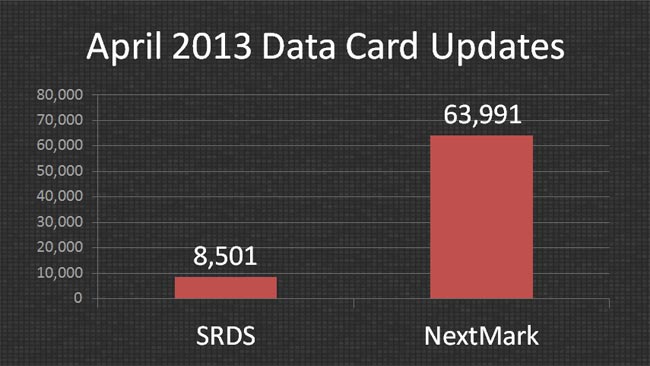
This morning, SRDS posted a tweet proclaiming, “Our data team made 8,501 updates the SRDS.com database in April.” One of our clients forwarded this to me and asked, “How many updates does NextMark make in a month? How does this compare to SRDS?”
Those are important questions. Having access to up-to-date data cards in a searchable database of media programs is critical in making efficient and effective media purchasing decisions for your clients. So, we did the research to find the answers.
During April 2013, we made 63,991 data card updates to the NextMark database. That’s more than 7.5 times the number of updates SRDS made during the same period. Furthermore, our monthly average for 2013 is slightly higher at 66,005 updates per month. As the numbers have proven, NextMark is delivering on our commitment to provide you with the world’s best database of advertising opportunities.
Want better media planning decision-making data in 18 different media channels? Use NextMark’s Multi-Channel Media Planner for traditional direct marketing channels and the new Digital Media Planner for digital advertising channels.
The post SRDS vs. NextMark data card database updates first appeared on NextMark.
We’re hiring: Senior Director of Agency Sales – New York City 20 May 2013 8:11 AM (12 years ago)
 Based on the early success the new Digital Media Planner tool, NextMark is ramping up its marketing and sales team in New York City. We’re seeking mid-level sales professionals with experience in selling technology to advertising agencies. This is a unique opportunity for you to get in on the ground floor of “programmatic direct” media buying with a new product that’s been validated in the marketplace at a company that’s already been profitable for 10 years selling media planning solutions on an enterprise-grade platform.
Learn more about the job: Senior Director of Agency Sales – New York City.
The post We’re hiring: Senior Director of Agency Sales – New York City first appeared on NextMark.
We’re hiring – Software QA Engineer – Hanover, NH 14 May 2013 5:31 AM (12 years ago)
Are you an experienced software quality assurance engineer looking for a new challenge? NextMark delivers state-of-the-art web-based solutions in the red-hot sector of advertising technology. Learn more about this job: Software QA Engineer Job – Hanover, NH.
The post We’re hiring – Software QA Engineer – Hanover, NH first appeared on NextMark.
Are Publisher Trading Desks Next? 13 May 2013 8:01 PM (12 years ago)
 This post originally appeared in AdExchanger.
A long time ago, I was selling highly premium banner ad inventory to major advertisers. Part of a larger media organization, our site had great consumer electronics content tailored to successful professional and amateur product enthusiasts. The thing we loved most was sponsorships and advertorials. We practically had a micro-agency inside our shop, and we produced amazing custom websites, contests, and branded content sections for our best clients. They loved our creative approach, subject matter expertise, and association with our amazing brand. They still capture this revenue today.
The next thing we loved was our homepage and index page banner inventory. We sold all of our premium inventory—mostly 728×90 and 300×250 banners—by hand, and realized very nice CPMs. Back then, we were getting CPMs upwards of $50, since we had an audience of high-spending B2B readers. I imagine that today, the same site is running lots of premium video and rich media, and getting CPMs in the high teens for their above-the fold inventory and pre-roll in their video player. I was on the site recently, and saw most of the same major advertisers running strong throughout the popular parts of the site. Today, a lot of this “transactional RFP” activity is being handled by programmatic direct technologies that include companies like NextMark, Centro, iSocket, and AdSlot, not to mention MediaOcean.
What about remnant? We really didn’t think about it much. Actually, realizing how worthless most of that below-the-fold and deep-paged inventory was, we ran house ads, or bundled lots of “value added ROS” impression together for our good customers. Those were simple days, when monetization was focused on having salespeople sell more—and pushing your editorial team to produce more content worthy of high CPM banner placements.
Come to think of it, it seems like not much has changed over the last 10 years, with the notable exception of publishers’ approach to remnant inventory. About five years ago, they found some ad tech folks to take 100% of it off their hands. Even though they didn’t get a lot of money for it, they figured it was okay, since they could focus on their premium inventory and sales relationships. In doing some of those early network deals, I wondered who the hell would want millions of below-the-fold banners and 468x90s, anyway? Boy, was I stupid. Close your eyes for a year or two, and a whole “Kawaja map” pops up.
Anyhow, we all know what happened next. Networks used data and technology to make the crap they were buying more relevant to advertisers (“audience targeting”), and the demand side—seeing CPMs drop from $17 to $7, played right along. Advertisers LOVE programmatic RTB buying. It puts them in the driver’s seat, lets them determine pricing, and also (thanks to “agency trading desks”) lets them enhance their shrinking margins with a media vigorish. Unfortunately, for publishers, it meant that a rising sea of audience targeting capability only lifted the agency and ad tech boats. Publishers were seeing CPMs decline, networks eat into overall ad spending, DSPs further devaluing inventory, and self-service platforms like Facebook siphon off more of the pie.
How do publishers get control back of their remnant inventory—and start to take their rightful ownership of audience targeting?
That has now become simple (well, it’s simple after some painful tech implementation). Data Management Platforms are the key for publishers looking to segment, target, and expand their audiences via lookalike modeling. They can leverage their clients’ first party data and their own to drive powerful audience-targeted campaigns right within their own domains, and start capturing real CPMs for their inventory rather than handing networks and SSPs the lion’s share of the advertising dollar. That is step number one, and any publisher with a significant amount of under-monetized inventory would be foolish to do otherwise. Why did Lotame switch from network to DMP years ago? Because they saw this coming. Now they help publishers power their own inventory and get back control. Understanding your audience—and having powerful insights to help your advertisers understand it—is the key to success. Right now, there are about a dozen DMPs that are highly effective for audience activation.
What is even more interesting to me is what a publisher can do after they start to understand audiences better. The really cool thing about DMPs is that they can enable a publisher to have their own type of “trading desk.” Before we go wild and start taking about “PTDs” or PTSDs or whatever, let me explain.
If I am BigSportsSite, for example, and I am the world’s foremost expert in sports content, ranking #1 or #2 in Comscore for my category, and consistently selling my inventory at a premium, what happens when I only have $800,000 in “basketball enthusiasts” in a month and my advertiser needs $1,000,000 worth? What happens today is that the agency buys up every last scrap of premium inventory he can find on my site and others, and then plunks the rest of her budget down on an agency trading desk, who uses MediaMath to find “basketball intenders” and other likely males across a wide range of exchange inventory.
But doesn’t BigSportsSite know more about this particular audience than anyone else? Aren’t they the ones with historical campaign data, access to tons of first-party site data, and access to their clients’ first party data as well? Aren’t they the ones with the content expertise which enables them to see what types of pages and context perform well for various types of creative? Also, doesn’t BigSportsSite license content to a larger network of pre-qualified, premium sites that also have access to a similar audience? If the answer to all of the above is yes, why doesn’t BigSportsSite run a trading desk, and do reach extension on their advertisers’ behalf?
I think the answer is that they haven’t had access to the right set of tools so far—and, more so, the notion of “audience discovery” has somehow been put in the hands of the demand side. I think that’s a huge mistake. If I’m a publisher who frequently runs out of category-specific inventory like “sports lovers,” I am immediately going to install a DMP and hire a very smart guy to help me when I can’t monetize the last $200,000 of an RFP. Advertisers trust BigSportsSite to be the authority in their audience, and (as importantly) the arbiter of what constitutes high quality category content.
Why let the demand side have all of the fun? Publishers who understand their audience can find them on their own site, their clients’ sites, across an affiliated network of partner sites, and in the long tail through exchanges. These multi-tiered audience packages can be delivered through one trusted partner, and aligned with their concurrent sponsorship and transactional premium direct advertising.
Maybe we shouldn’t call them Publisher Trading Desks, but every good publisher should have one.
The post Are Publisher Trading Desks Next? first appeared on NextMark.
“Air Traffic Control” for Media RFP Proposal Management 10 May 2013 8:00 AM (12 years ago)
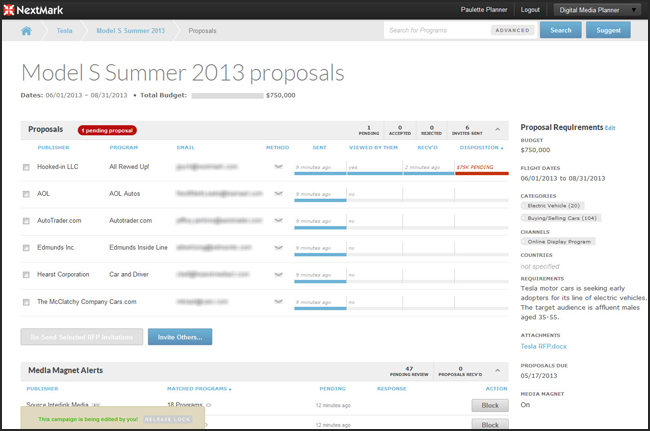
Last night, NextMark’s Digital Media Planning system was upgraded to give you a new tool for automatically keeping track of your Requests for Proposals (RFPs) and the proposals that come in response.
RFP management in digital advertising is well-known to be a frustrating mess. Despite recently celebrating the eighteenth anniversary of the banner ad, sending RFP requests and handling proposal responses is still a highly manual effort involving emails, Excel spreadsheets, shared file folders, phone calls, sticky notes, and plenty of manual labor. Despite its many failings and costing agencies more than $3,000 per campaign in labor, nobody has yet developed a widely adopted alternative to this time consuming and expensive process.
Fresh on the heels of version 2.0, NextMark Planner v2.1, released May 9, 2013, brings much needed automation to RFP management:
- Send RFPs from your media plan – with contacts pre-filled for you (no more tracking down contact info)!
- Automatically keeps track of who has viewed your RFP and who has responded with a proposal
- Makes it easy to send reminders to those that have not responded
- Automatically organizes all your proposals and documents (screen shots, media kits, etc.) all in one place
- One-click access to proposal details
- One-click accept or reject of proposals
- Automatically tracks the status of every proposal – pending, accepted, or rejected
- All this and more in a clean and super easy-to-use interface
This new set of features is now available to you if you’re using NextMark Planner. If you don’t yet have access, you can request it here: www.NextMark.com/planner.
The post “Air Traffic Control” for Media RFP Proposal Management first appeared on NextMark.
2013 Will be the Year of Programmatic Direct 6 May 2013 8:01 PM (12 years ago)

A version of this post originally appeared in ClickZ.
Fairfax Cone, the founder of Foote, Cone, and Belding once famously remarked that the problem with the agency business was that “the inventory goes down the elevator at night.” He was talking about the people themselves. For digital media agencies, who rely on 23 year-old media planners to work long hours grinding on Excel spreadsheets and managing vendors, that might be a problem.
For all of the hype and investment behind real-time bidding, the fact is that “programmatically bought” media (RTB) will only account for roughly $2B of the anticipated $15B in digital display spending this year, or a little over 13% depending on who you believe. Even if that number were to double, the lion’s share of digital display still happens the old fashioned way: Publishers hand-sell premium guaranteed inventory to agencies.
Kawaja map companies, founded to apply data and technology to the problem of audience buying, have gotten the most ink, most venture funding, and most share of voice over the past 5 years. The amount of innovation and real technology that has been brought to bear on audience targeting and optimization has been huge, and highly valuable. Today, platforms like The Rubicon Project process over a trillion ad bids and over 100B ad transactions every month. Companies like AppNexus have paid down technology pipes that bring the power of extensible platform technology to large and small digital advertising businesses alike. And inventory? There are over 5 trillion impressions a month ready to be purchased, most of which sit in exchanges powered by just such technology.
All of that bring said, the market continues to put the majority of its money into premium guaranteed. They are, in effect, saying, “I know I can buy the ‘sports lovers’ segment through my DSP, and I will—but what I really want is to reach sports lovers where they love to go: ESPN.com.”
So, while RTB and related ad technologies will grow, they will not grow fast enough to support all of the many companies in the ecosystem that need a slice of 2013’s $2B RTB pie to survive. NextMark founder and CEO, Joseph Pych, whose company focuses on guaranteed reserved software, has been calling this the great “Sutton Pivot,” referring to the famous remark of criminal Willie Sutton , who robbed banks “because that’s where the money is.”
In order to better inderstand why this is happening, I have identified several problems with RTB that are driving companies focused on RTB to need to pivot:
- There’s a Natural Cap on RTB Growth: I think today’s RTB technology is the best place to buy remnant inventory. As long as there are low-value impressions to buy, and as long as publishers continue to festoon their pages with IAB-standard banners, there will need to be a technology solution to navigate through the sea of available inventory, and apply data (and algorithms) to choose the right combination of inventory and creative to reach defined performance goals. While the impressions may grow, the real cap on RTB growth will be the most important KPI of them all: Share of time spent. Marketers spend money where people spend their time, whether it’s on television, Twitter, radio, or Facebook. When people spend less time on the inventory represented within exchanges, then the growth trend will reverse itself. (Already we are seeing a significant shift in budget allocation from “traditional” exchanges to FBX).
- The Pool is Still Dirty: It goes without saying, but the biggest problem in terms of RTB growth is brand safety. The type of inventory available in exchanges that sells, on average, for less than a dollar is probably worth just that. When you buy an $850 suit from Joseph A. Bank—and receive two free suits, two shirts, and two ties—you feel good. But it doesn’t take much figuring to understand that you just bought 3 $200 suits, two $75 shirts, and two $50 ties. Can you get $15 CPM premium homepage inventory for $3 CPM? No…and you never will be able to, but that type of inventory is just what the world’s largest marketers want. They would also like URL-level transparency into where their ads appeared, a limit on the number of ads on a page (share of voice), and some assurance that their ads are being seen (viewability). Inventory will continually grow, but good, premium inventory will grow more slowly.
- It’s Not about Private Exchanges: Look, there’s nothing wrong with giving certain advertisers a “first look” at your premium inventory if you are a publisher. Auto sites have been pursuing this concept forever. Big auto sites guarantee Ford, for example, all of the banner inventory associated with searches for Ford-branded vehicles over the course of a year. This ensures the marketer gets to his prospect when deep in the consideration set. Big auto sites may create programmatic functionality around enabling this type of transaction, but private exchange functionality isn’t going to be the savior of RTB, just necessary functionality. Big marketers want control of share of voice, placement, and flexibility in rates and programs that extend beyond the functionality currently available in DSPs. As long as they are spending the money, they will get—and demand—service.
What does all of this mean? RTB-enables ad technology is not going away, but some of the companies that require real time bidding to grow at breakneck speed to survive are going to pivot towards the money, developing technologies that enable more efficient buying of premium guaranteed inventory—where the other 85% of media budgets happen. I predict that 2013 will be the year of “programmatic direct” which will be the label that people apply to any technology that enables agencies and marketers to access reserved inventory more efficiently. If we can apply some of the amazing technology we have built to making buying (and selling) great inventory easier, more efficient, and better performing, it will be an amazing year.
The post 2013 Will be the Year of Programmatic Direct first appeared on NextMark.